Metaflow
Metaflow is an open-source, human-centric Python framework that helps data scientists and engineers build, run, and manage data-intensive workflows for data science, machine learning, and AI. Netflix originally developed Metaflow, and open sourced it in 2019. When you integrate Metaflow with Scality ARTESCA, Metaflow uses ARTESCA as its S3-compatible datastore for run snapshots, code packages, data artifacts, and metadata. This delivers reproducible and versioned ML pipelines on enterprise on-premises object storage.
Prerequisites
An active Linux server with network access to the ARTESCA S3 endpoint.
Set Up Resources for Metaflow
Create an Account for Metaflow.
Create a bucket (e.g.
metaflow) to store data and artifacts.Create Identity and Access Management (IAM) users for Metaflow.
Create an IAM policy to grant Metaflow access to the S3 bucket.
The following policy grants Metaflow least-privilege access to the bucket and the necessary bucket-level metadata operations.
Note
Replace each
bucket_nameplaceholder in the policy with the actual name of your bucket.{ "Version": "2012-10-17", "Statement": [ { "Effect": "Allow", "Action": [ "s3:PutObject", "s3:GetObject", "s3:DeleteObject", "s3:ListBucket", "s3:GetBucketLocation", "s3:GetBucketVersioning", "s3:GetBucketObjectLockConfiguration" ], "Resource": [ "arn:aws:s3:::bucket_name", "arn:aws:s3:::bucket_name/*" ] } ] }
Install Certificates
Integrate Metaflow with ARTESCA
Apply these steps to a Linux server with access to the ARTESCA instance.
Create a Python virtual environment and install Metaflow.
Note
Refer to the Metaflow installation documentation for more information.
python3 -m venv ~/metaflow-venv
source ~/metaflow-venv/bin/activate
pip install metaflow boto3
Create the Metaflow configuration directory.
mkdir -p ~/.metaflow
Write the following content to
~/.metaflow/config.json.Note
Replace the
<YOUR_BUCKET_NAME_PLACEHOLDER>,<YOUR_ENDPOINT_PLACEHOLDER>, and<YOUR_CERTIFICATE_PATH_PLACEHOLDER>placeholders with the real values.{ "METAFLOW_DEFAULT_DATASTORE": "s3", "METAFLOW_DATASTORE_SYSROOT_S3": "s3://<YOUR_BUCKET_NAME_PLACEHOLDER>/metaflow", "METAFLOW_S3_ENDPOINT_URL": "https://<YOUR_ENDPOINT_PLACEHOLDER>", "METAFLOW_S3_VERIFY_CERTIFICATE": "<YOUR_CERTIFICATE_PATH_PLACEHOLDER>/artesca-ca.pem", "METAFLOW_S3_ADDRESSING_STYLE": "path" }Export the IAM credentials in the shell environment.
Note
Replace all five placeholders with the real values:
<YOUR_ACCESS_KEY_PLACEHOLDER>,<YOUR_SECRET_KEY_PLACEHOLDER>,<YOUR_S3_ENDPOINT_URL_PLACEHOLDER>,<YOUR_S3_BUCKET_PLACEHOLDER>, and<YOUR_CA_BUNDLE_PATH_PLACEHOLDER>.export AWS_ACCESS_KEY_ID='<YOUR_ACCESS_KEY_PLACEHOLDER>' export AWS_SECRET_ACCESS_KEY='<YOUR_SECRET_KEY_PLACEHOLDER>' export AWS_S3_ENDPOINT_URL='<YOUR_S3_ENDPOINT_URL_PLACEHOLDER>' export AWS_S3_BUCKET='<YOUR_S3_BUCKET_PLACEHOLDER>' export AWS_CA_BUNDLE='<YOUR_CA_BUNDLE_PATH_PLACEHOLDER>'
Create a file named
metaflow_artesca.pywith the following content.This flow generates a 100 MiB sample dataset, uploads it to ARTESCA, downloads it back using the Metaflow S3 client, applies gzip compression, and uploads the optimized artifact and accompanying metadata. It uses a single Metaflow S3 integration path (no boto3 fallback logic).
import gzip
import hashlib
import json
import os
import time

from metaflow import FlowSpec, S3, current, step

# --- Required environment variables (set these before running) ---
# AWS_ACCESS_KEY_ID        - S3 access key
# AWS_SECRET_ACCESS_KEY    - S3 secret key
# AWS_S3_ENDPOINT_URL      - Artesca endpoint, e.g. https://s3.artesca.example.com
# AWS_S3_BUCKET            - target bucket name
# AWS_CA_BUNDLE            - path to artesca-ca.pem
_REQUIRED_ENV_VARS = [
    'AWS_ACCESS_KEY_ID',
    'AWS_SECRET_ACCESS_KEY',
    'AWS_S3_ENDPOINT_URL',
    'AWS_S3_BUCKET',
    'AWS_CA_BUNDLE',
]

def _validate_environment():
    missing = [v for v in _REQUIRED_ENV_VARS if not os.environ.get(v)]
    if missing:
        raise EnvironmentError(f"Missing required environment variables: {', '.join(missing)}")

    ca_bundle = os.environ['AWS_CA_BUNDLE']
    if not os.path.exists(ca_bundle):
        raise FileNotFoundError(f"SSL certificate not found: {ca_bundle}")


def generate_large_dataset(size_in_mib: int) -> bytes:
    """Return a synthetic CSV dataset of approximately *size_in_mib* MiB as UTF-8 bytes."""
    print(f"Generating {size_in_mib} MiB dummy dataset...", flush=True)

    target_bytes = size_in_mib * 1024 * 1024
    categories = ['electronics', 'clothing', 'books', 'sports', 'home', 'automotive']
    regions = ['north', 'south', 'east', 'west', 'central']
    statuses = ['active', 'pending', 'completed', 'cancelled']

    lines = []
    current_size = 0
    record_id = 0

    while current_size < target_bytes:
        category = categories[record_id % len(categories)]
        region = regions[record_id % len(regions)]
        status = statuses[record_id % len(statuses)]
        price = 10.99 + (record_id % 1000) * 0.50
        quantity = 1 + (record_id % 100)
        line = (
            f"{record_id:08d},{category},{region},{price:.2f},{quantity},{status},"
            f"2024-07-{(record_id % 30) + 1:02d},"
            f"product_{record_id % 500:03d},description_for_product_{record_id % 200:03d}\n"
        )
        encoded = line.encode('utf-8')
        lines.append(encoded)
        current_size += len(encoded)
        record_id += 1

        if record_id % 50000 == 0:
            print(f"  Generated {current_size / (1024 * 1024):.1f} MiB ({record_id:,} records)...", flush=True)

    data = b''.join(lines)
    print(f"Dataset ready: {len(data) / (1024 * 1024):.2f} MiB, {record_id:,} records", flush=True)
    return data


class ArtescaS3Dataset100MiB(FlowSpec):
    """Metaflow flow: generate, upload, compress, and verify a 100 MiB dataset on Artesca S3."""

    @step
    def start(self):
        """Validate environment, generate 100 MiB dataset, and upload to S3."""
        _validate_environment()

        dataset_bytes = generate_large_dataset(100)
        size_mib = len(dataset_bytes) / (1024 * 1024)

        self.original_data_hash = hashlib.sha256(dataset_bytes).hexdigest()
        self.original_data_size = len(dataset_bytes)
        self.dataset_size_mib = size_mib

        print(f"Dataset: {size_mib:.2f} MiB, SHA-256: {self.original_data_hash}", flush=True)

        s3_root = f"s3://{os.environ['AWS_S3_BUCKET']}/original-storage/{current.run_id}"
        key = "dummy_dataset_100mib.csv"

        t0 = time.time()
        with S3(s3root=s3_root) as s3:
            s3.put(key, dataset_bytes)
        elapsed = time.time() - t0

        self.original_s3_path = f"{s3_root}/{key}"
        print(f"Uploaded to {self.original_s3_path} in {elapsed:.1f}s ({size_mib * 8 / elapsed:.1f} Mbps)", flush=True)

        self.next(self.transform_and_optimize)

    @step
    def transform_and_optimize(self):
        """Download the dataset, verify integrity, compress, and upload the optimized copy."""
        print(f"Downloading {self.dataset_size_mib:.2f} MiB from {self.original_s3_path}", flush=True)

        t0 = time.time()
        with S3() as s3:
            dataset_bytes = s3.get(self.original_s3_path).blob
        print(f"Downloaded in {time.time() - t0:.1f}s", flush=True)

        actual_hash = hashlib.sha256(dataset_bytes).hexdigest()
        if actual_hash != self.original_data_hash:
            raise RuntimeError(
                f"Integrity check failed: expected {self.original_data_hash}, got {actual_hash}"
            )
        print("Data integrity verified (SHA-256 match)", flush=True)

        lines_count = dataset_bytes.count(b'\n')
        print(f"Records: {lines_count:,}", flush=True)

        t0 = time.time()
        compressed = gzip.compress(dataset_bytes, compresslevel=6)
        compression_time = time.time() - t0

        original_mib = self.original_data_size / (1024 * 1024)
        compressed_mib = len(compressed) / (1024 * 1024)
        ratio_pct = (1 - len(compressed) / self.original_data_size) * 100

        print(
            f"Compressed {original_mib:.2f} MiB -> {compressed_mib:.2f} MiB "
            f"({ratio_pct:.1f}% reduction) in {compression_time:.1f}s",
            flush=True,
        )

        self.optimization_info = {
            'type': 'gzip_compression',
            'original_size_mib': round(original_mib, 2),
            'optimized_size_mib': round(compressed_mib, 2),
            'compression_ratio_percent': round(ratio_pct, 1),
            'compression_time_seconds': round(compression_time, 1),
            'compression_speed_mbps': round(original_mib * 8 / compression_time, 1),
            'records_processed': lines_count,
            'compression_level': 6,
            'timestamp': int(time.time()),
        }

        s3_root = f"s3://{os.environ['AWS_S3_BUCKET']}/optimized-storage/{current.run_id}"
        t0 = time.time()
        with S3(s3root=s3_root) as s3:
            s3.put("optimized_dataset_100mib.csv.gz", compressed)
            s3.put("optimization_metadata.json", json.dumps(self.optimization_info, indent=2).encode('utf-8'))
        elapsed = time.time() - t0

        self.optimized_s3_path = f"{s3_root}/optimized_dataset_100mib.csv.gz"
        self.metadata_s3_path = f"{s3_root}/optimization_metadata.json"
        print(f"Uploaded optimized dataset in {elapsed:.1f}s ({compressed_mib * 8 / elapsed:.1f} Mbps)", flush=True)

        self.next(self.report)

    @step
    def report(self):
        """Print a structured summary of the run."""
        info = self.optimization_info
        bucket = os.environ['AWS_S3_BUCKET']
        endpoint = os.environ['AWS_S3_ENDPOINT_URL']
        bandwidth_saved = info['original_size_mib'] - info['optimized_size_mib']

        print("\nS3 STORAGE OPTIMIZATION REPORT", flush=True)
        print("=" * 60, flush=True)
        print("\nOriginal dataset", flush=True)
        print(f"  Path:    {self.original_s3_path}", flush=True)
        print(f"  Size:    {info['original_size_mib']} MiB", flush=True)
        print(f"  Records: {info['records_processed']:,}", flush=True)
        print(f"  Hash:    {self.original_data_hash}", flush=True)
        print("\nOptimized dataset", flush=True)
        print(f"  Data:        {self.optimized_s3_path}", flush=True)
        print(f"  Metadata:    {self.metadata_s3_path}", flush=True)
        print(f"  Size:        {info['optimized_size_mib']} MiB", flush=True)
        print(f"  Reduction:   {info['compression_ratio_percent']}% ({bandwidth_saved:.1f} MiB saved)", flush=True)
        print("\nBucket layout", flush=True)
        print(f"  s3://{bucket}/original-storage/   -> source datasets", flush=True)
        print(f"  s3://{bucket}/optimized-storage/  -> compressed datasets", flush=True)
        print(f"\nEndpoint: {endpoint}", flush=True)

        self.next(self.end)

    @step
    def end(self):
        """Flow completion marker."""
        info = self.optimization_info
        print(
            f"\nDone: {info['original_size_mib']} MiB -> {info['optimized_size_mib']} MiB "
            f"({info['compression_ratio_percent']}% reduction, {info['records_processed']:,} records)",
            flush=True,
        )


if __name__ == '__main__':
    ArtescaS3Dataset100MiB()
Run the flow.
python metaflow_artesca.py run
Metaflow validates the flow graph and executes each step. The output must contain:
The dataset upload (
dummy_dataset_100mib.csv).The optimized artifact upload (
optimized_dataset_100mib.csv.gz).The metadata upload (
optimization_metadata.json).An SHA-256 integrity check.
A final performance report.
Verify the Integration
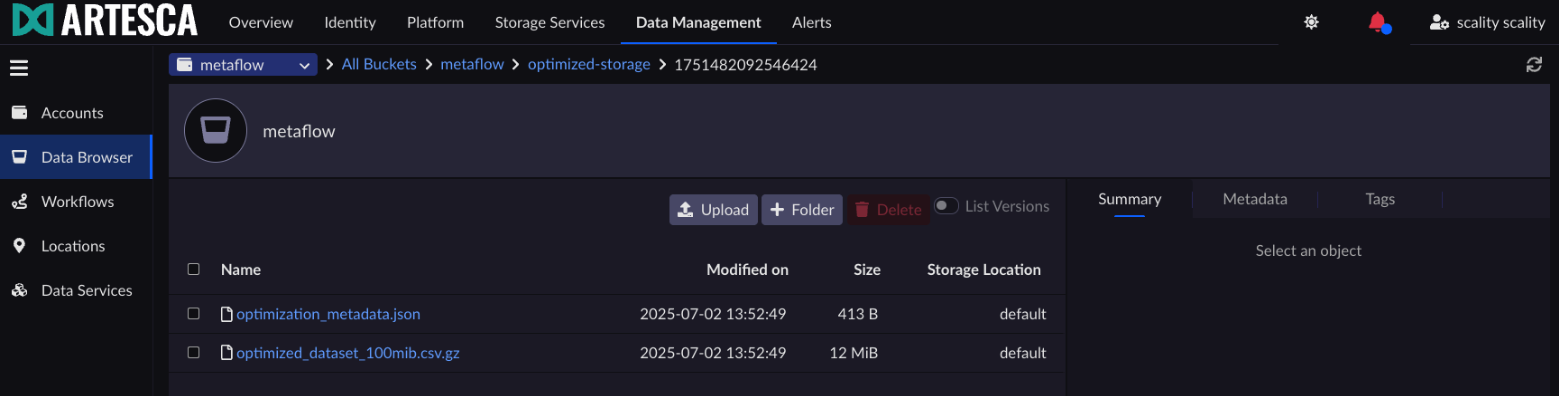
Access the ARTESCA UI, and navigate to your S3 bucket.
Confirm the following objects exist under
optimized-storage/<run_id>/in the bucket (where<run_id>is printed in the flow output):optimized_dataset_100mib.csv.gzoptimization_metadata.json