

CTERA
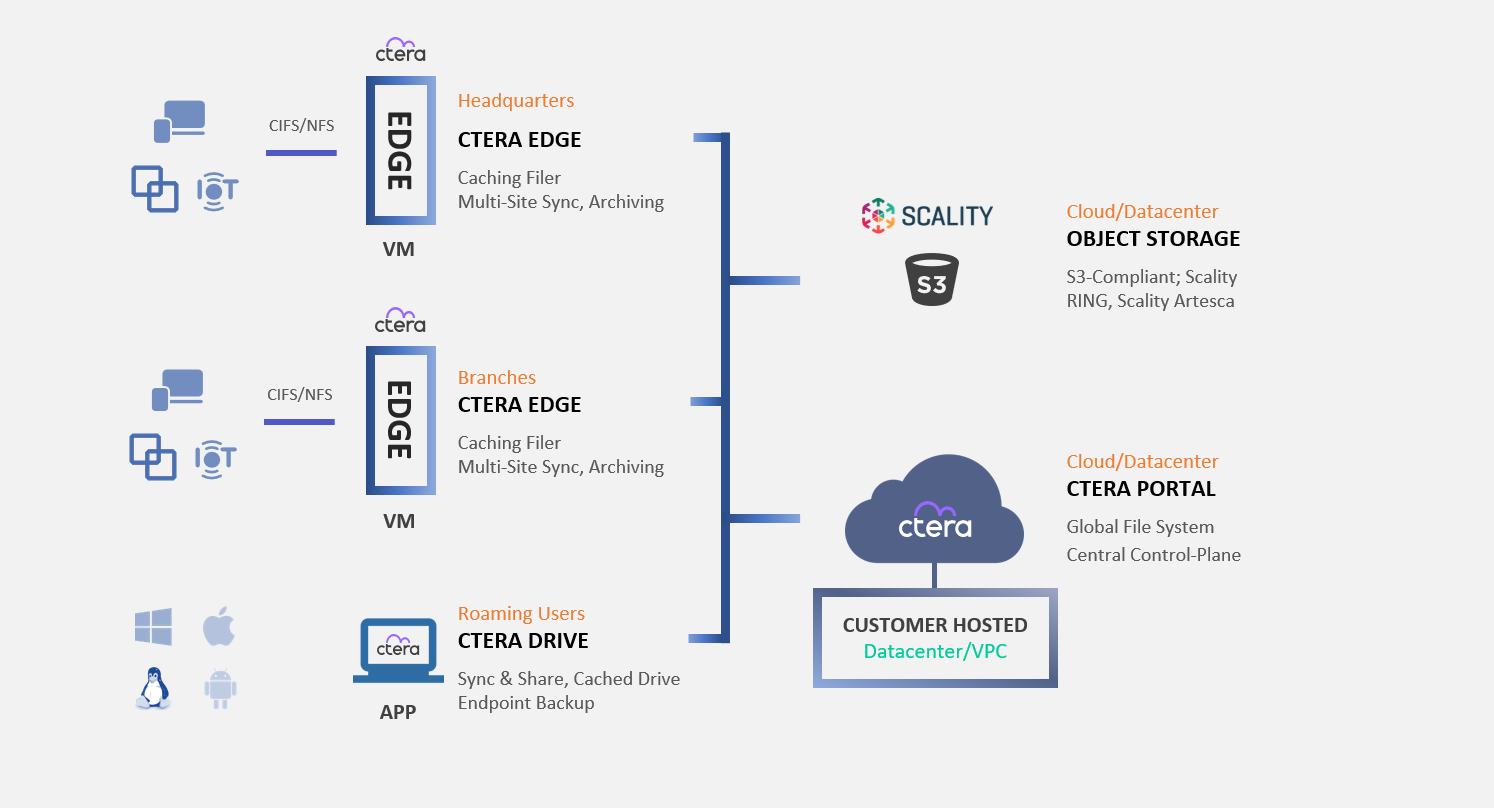
CTERA provides the industry’s most comprehensive Global File System with military-grade security, ultra-fast performance that scales to thousands of distributed sites and tens of thousands of users in a single namespace. The CTERA Enterprise File Services Platform modernizes distributed edge-NAS infrastructure, streamlines data archive, disaster recovery procedures, and facilitates global file collaboration, and automates unstructured data workflows across private, public or hybrid clouds. The CTERA Global File System features a hub-and-spoke (edge-to-core) architecture, consisting of a centralized metadata catalog and control plane known as the “CTERA Portal,” remote edge-NAS caching appliances known as “CTERA Edge Filers”.
CTERA Portal The CTERA Portal serves as the central component in CTERA’s Global File System, handling the presentation of the Global Namespace and indexing of metadata for all managed files and objects.
CTERA Edge Filer The CTERA Edge Filer functions as the NAS front-end to the CTERA Global File System, providing CIFS/NFS file presentation coupled with continuous data protection, archiving, and caching for frequently accessed files. This component is deployed as a virtual appliance, compatible with on-premises hypervisors such as KVM, VMware, and HyperV, as well as cloud platforms like Amazon EC2, Azure, and GCP.
CTERA: Edge to Core File Services Architecture The following diagram provides a high-level depiction of the CTERA Global File System and its individual components. CTERA, responsible for global file presentation, caching, and file metadata indexing, utilizes S3-Compatible object storage to store the globally deduplicated data payloads. The CTERA platform supports a wide range of on-premises and cloud object storage platforms, including Scality RING and Scality ARTESCA.
Supported Architectures
CTERA integrates with ARTESCA over S3. Currently the following configurations are supported:


